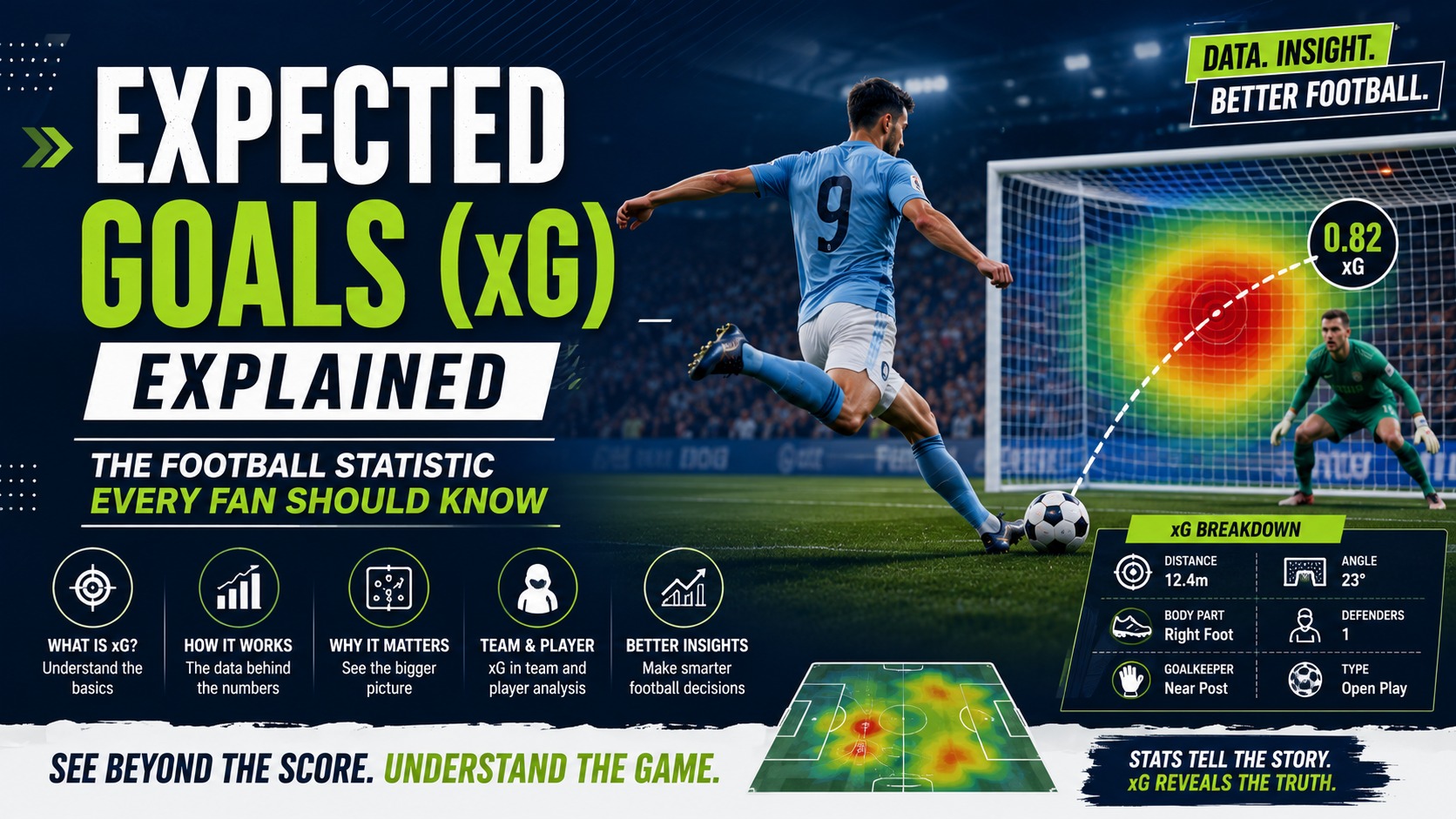
Expected Goals (xG) Explained: The Football Statistic Every Fan Should Know
Football has evolved far beyond goals, assists, and possession statistics. Today, clubs, analysts, broadcasters, and fans rely on advanced data to better understand team and player performances.
One of the most influential metrics in modern football is Expected Goals (xG).
Whether you’re following the Premier League, La Liga, UEFA Champions League, or international tournaments, you’ll often hear commentators discussing xG after every match.
But what exactly does it mean?
In this guide, we’ll explain Expected Goals in simple terms, how it works, why clubs use it, and why it has become one of football’s most valuable performance metrics.
What Is Expected Goals (xG)?
Expected Goals, commonly abbreviated as xG, is a statistical model that estimates the probability of a shot resulting in a goal.
Each shot receives a value between 0 and 1.
For example:
- 0.05 xG = 5% chance of scoring
- 0.25 xG = 25% chance
- 0.60 xG = 60% chance
- 0.90 xG = Very likely to become a goal
The higher the xG value, the greater the likelihood that the shot should result in a goal.
How Is xG Calculated?
Expected Goals models analyze thousands of historical shots and compare several important factors.
These include:
- Distance from goal
- Shooting angle
- Body part used (foot or header)
- Type of assist
- Defensive pressure
- Goalkeeper positioning
- Open play or set piece
- Shot location
Each factor contributes to the final probability assigned to the shot.
Why Is xG Important?
Goals alone don’t always tell the full story.
Imagine Team A wins 1–0 but creates only one chance throughout the match.
Meanwhile, Team B creates eight excellent opportunities but fails to score due to outstanding goalkeeping.
Traditional statistics suggest Team A deserved the win.
Expected Goals reveals which team actually created the better scoring opportunities.
This makes xG a valuable tool for evaluating overall performance.
Team xG vs Player xG
There are two main ways Expected Goals is used.
Team xG
Measures the quality of scoring chances created by an entire team.
Higher team xG usually indicates stronger attacking performances.
Player xG
Measures how many quality scoring opportunities an individual player receives.
Over a full season, players with consistently high xG numbers often become the league’s top scorers.
Why Football Clubs Use xG
Professional clubs increasingly rely on analytics departments to support coaching and recruitment.
Expected Goals helps clubs:
- Evaluate attacking efficiency
- Improve finishing
- Scout new players
- Measure tactical effectiveness
- Compare performances over time
- Identify underperforming or overperforming players
Many of Europe’s biggest clubs integrate xG into their weekly performance reviews.
Common Misunderstandings About xG
Many fans assume a higher xG guarantees victory.
This is not true.
Football remains unpredictable.
A team can generate a high Expected Goals total yet fail to score due to excellent goalkeeping, poor finishing, or bad luck.
Similarly, a team with a lower xG can still win by converting limited chances efficiently.
Other Advanced Football Statistics
Expected Goals is only one part of football analytics.
Other important metrics include:
Expected Assists (xA)
Measures the quality of passes leading to shots.
Expected Goals Against (xGA)
Estimates the quality of chances a team allows its opponents.
Progressive Passes
Tracks forward passes that significantly advance the ball.
Progressive Carries
Measures how effectively players move the ball up the pitch through dribbling.
Pass Completion Percentage
Evaluates passing accuracy under different levels of pressure.
How Fans Can Use xG
Expected Goals helps supporters better understand match performances.
Instead of judging teams only by the final score, fans can analyze:
- Chance quality
- Finishing efficiency
- Tactical effectiveness
- Defensive organization
- Long-term consistency
This provides a more complete picture of how teams perform across a season.
The Future of Football Analytics
Data continues to shape modern football.
Clubs now combine advanced statistics with video analysis, GPS tracking, and artificial intelligence to improve player development and tactical planning.
Expected Goals remains one of the most widely used metrics because it simplifies complex attacking performance into an easy-to-understand number.
As football analytics continues to evolve, fans will likely see even more sophisticated performance metrics become part of everyday discussions.
Conclusion
Expected Goals (xG) has transformed the way football is analyzed.
Rather than focusing solely on goals scored, xG measures the quality of scoring opportunities, providing deeper insight into team and player performances.
Whether you’re a casual supporter or a dedicated football enthusiast, understanding xG can help you appreciate the tactical and statistical side of the game.
Stay connected with Footeo for more football analysis, tactical guides, player insights, match previews, and the latest news from the world’s biggest competitions.
Frequently Asked Questions
What does xG mean in football?
Expected Goals (xG) estimates the probability that a shot will result in a goal based on historical data and shot characteristics.
Is a higher xG always better?
Generally, yes. A higher xG indicates that a team or player is creating better-quality scoring opportunities, although it doesn’t guarantee goals.
Do professional football clubs use xG?
Yes. Many clubs use Expected Goals as part of their performance analysis, scouting, and tactical planning.
Can fans use xG to understand matches?
Absolutely. xG helps explain why a match may have ended differently from what the final score alone suggests.
Primary SEO Keywords
- Expected Goals
- xG explained
- What is xG in football
- Football analytics
- Football statistics
Secondary SEO Keywords
- Advanced football stats
- xG football guide
- Football performance analysis
- Team xG
- Player xG
- Football data analysis
- Football metrics
- Soccer analytics
- Football tactics
- Modern football statistics
Suggested Internal Links
- Football Statistics
- Match Analysis
- Tactical Guides
- Player Profiles
- Football News
- Team Analysis
- Champions League Coverage
Suggested Image Alt Text
- Football analytics dashboard showing Expected Goals (xG) data
- Soccer player taking a shot with xG heatmap overlay
- Tactical football analysis on a digital screen
- Modern football statistics visualization with pitch graphic